High-Speed Ethernet for Modern Robotic Systems
Modern industrial automation requires more than reliable mechanical movement. Robots, machine vision cameras, sensors and control systems must continuously exchange increasing amounts of data.
This creates a challenge when Ethernet-connected devices are installed on a rotating part of a machine: how can high-speed data pass between stationary and rotating components without twisting the cables?
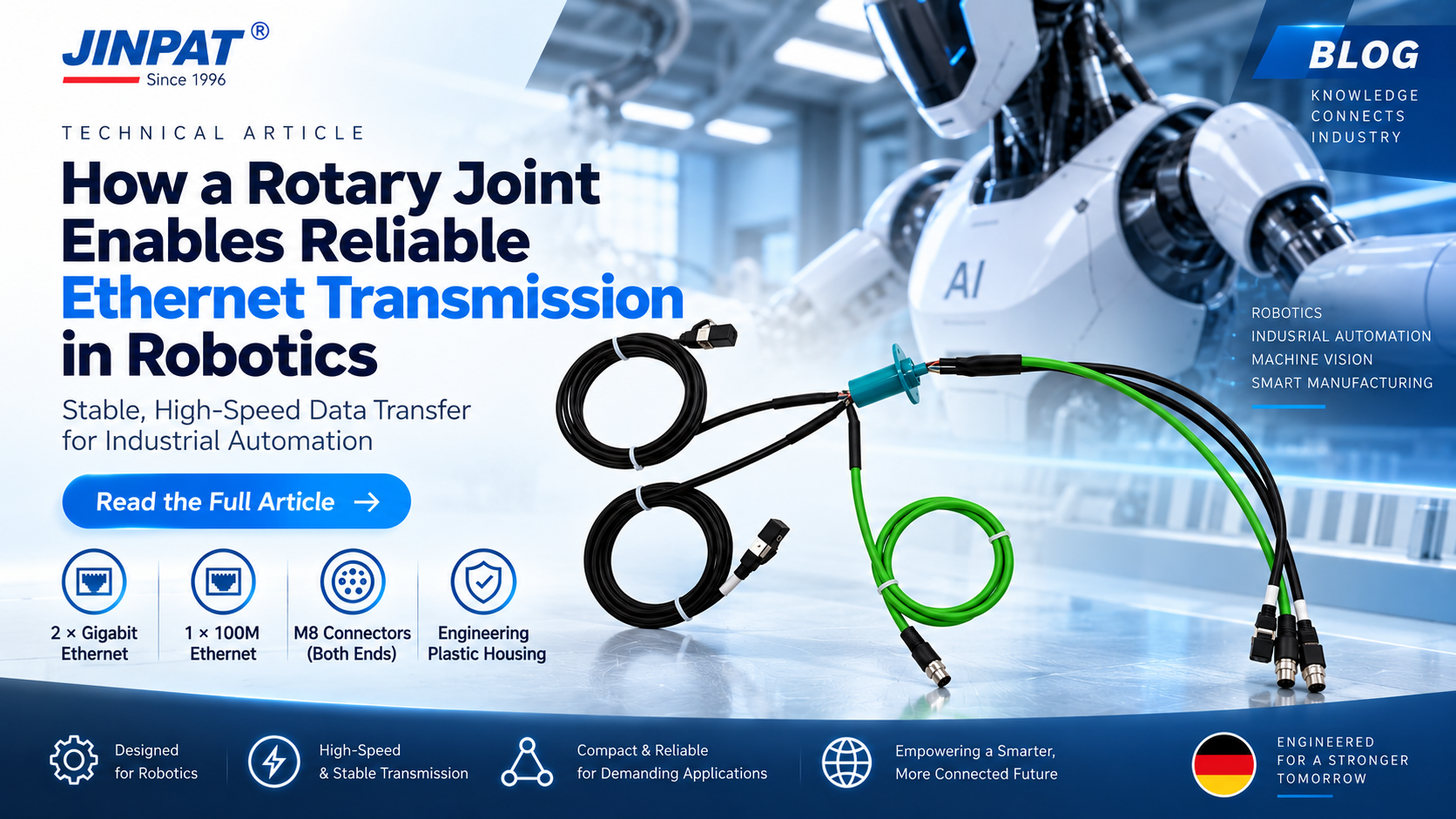
- JINPAT LPC-30-01E2-02E3 (JP48-123-002HW) is an Ethernet slip ring for robotics and industrial automation, designed to provide a rotary connection for high-speed network communication.
Its Ethernet configuration includes:
- 2 × Gigabit Ethernet channels
- 1 × 100M Ethernet channel
- M8 connectors
- Engineering plastic housing
- Designed for robotic and industrial automation applications
This combination makes the slip ring particularly suitable for machines that require multiple Ethernet connections across a rotating interface.
Why Multiple Ethernet Channels Matter in Robotics
Industrial robots are becoming increasingly data-driven. A modern robotic system may include cameras, sensors, controllers and other network-connected devices.
For example, one Gigabit Ethernet channel can be used for a machine vision camera, while the second Gigabit channel supports another high-bandwidth device. The additional 100M Ethernet channel can be used for control or auxiliary communication.
By integrating multiple Ethernet channels into the rotating interface, the LPC-30-01E2-02E3 robot slip ring gives engineers greater flexibility when designing the communication architecture of robotic equipment.
Potential applications include industrial robot arms, rotating robot joints, automated handling systems, inspection robots and intelligent assembly equipment.
Supporting Machine Vision and Automated Inspection
Machine vision is an important part of modern manufacturing, especially in automated inspection and quality control.
Industrial cameras are widely used for surface inspection, component positioning, dimensional measurement, defect detection and assembly verification.
When cameras or sensors are mounted on rotating mechanisms, conventional Ethernet cables can restrict movement. A Gigabit Ethernet slip ring allows high-speed network data to pass through the rotating interface while maintaining the required mechanical rotation.
This makes the LPC-30-01E2-02E3 relevant for machine vision systems, automated inspection equipment and rotating vision platforms where both mobility and high-speed communication are required.
A Rotary Data Solution for Industry 4.0
For German and European machine builders, Industry 4.0 is closely connected with intelligent automation, industrial networking and data-driven production.
Machines are no longer isolated mechanical systems. They continuously communicate with cameras, sensors, controllers and factory networks.
As a result, the role of the slip ring is also changing.
Instead of transmitting only power or basic electrical signals, modern rotary interfaces may need to handle power, control signals and high-speed data simultaneously.
An industrial Ethernet slip ring therefore becomes an important component in connected manufacturing equipment.
Compact M8 Connectivity
Installation space is another important consideration in robotics and automated machinery.
The LPC-30-01E2-02E3 uses M8 connectors, providing a compact connection interface for industrial systems. This makes the product suitable for applications where space around the rotating mechanism is limited.
Connectorized designs can also simplify machine integration, wiring and maintenance.
Why Gigabit Ethernet Requires a Dedicated Slip Ring
Ethernet should not be treated as a generic electrical signal when selecting a slip ring.
Gigabit Ethernet involves high-speed differential data transmission, making signal integrity and interference control important considerations in the rotary transmission design.
For this reason, engineers should clearly specify the required Ethernet speed when selecting an Ethernet rotary joint.
If Gigabit Ethernet is required, this should be stated explicitly rather than simply specifying “signal circuits.”
Selecting the Right Ethernet Slip Ring
When selecting an Ethernet slip ring for a robotic or automated machine, engineers should consider:
- Number and speed of Ethernet channels
- Electrical circuits, voltage and current
- Other signal requirements
- Rotational speed
- Installation dimensions
- Connector configuration
- Operating environment
These parameters help determine whether a standard configuration can be used or whether a customized rotary transmission solution is required.
Connecting Robotics with High-Speed Data
As robotics and industrial automation become increasingly connected, reliable data transmission through rotating interfaces is becoming more important.
- JINPAT LPC-30-01E2-02E3 (JP48-123-002HW) combines 2 Gigabit Ethernet channels, 1 100M Ethernet channel and M8 connectors, making it suitable for industrial robots, machine vision systems and automated equipment.
For machine builders developing connected robotic or Industry 4.0 equipment, it provides a practical solution for maintaining Ethernet communication across rotating components.
Looking for an Ethernet slip ring for your robotic or automation project? Contact JINPAT with your Ethernet channels, electrical requirements, rotational speed and installation dimensions to discuss a suitable solution.